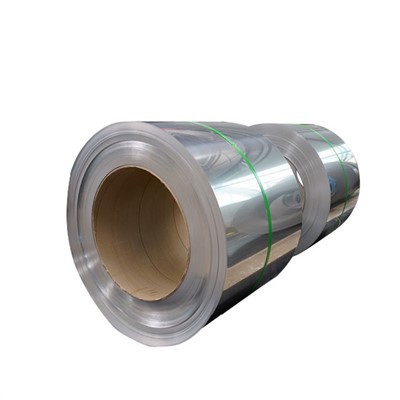
No. 1 Stainless Steel Coil is just hot rolled stainless steel coil with a No. 1 surface. It's got a rough, matte look that you get after it's been hot rolled, heated, and had the scale removed. It's a pretty basic stainless steel surface and is used a lot when strength, rust prevention, and how it handles being worked on are more important than looks.
To make it, they roll the steel at high heat and then heat treat it to make it easier to bend and get rid of stress inside the steel. The layer that forms when it's rolled is taken off using pickling or shot blasting. This leaves a consistent, but industrial-looking surface. It's not shiny, but it keeps all the good stuff about stainless steel, so it's good for building and making things.
What's in it depends on the type of steel. For instance, 304 and 316 coils have chromium and nickel to stop rust, while types that are mostly chromium. But no matter what, the No. 1 surface keeps the steel's basic traits without having to cold roll or polish it. Because it balances cost and function, No. 1 Stainless Steel Coil is often used for things like pressure tanks and heavy construction.
Product Details


Specifications & Technical Parameters
| Standards | ASTM A240 / ASME SA240 EN 10088 JIS G4304 / G4305 |
| Thickness | 3.0 mm – 50.0 mm |
| Width | 1000 mm – 2000 mm |
| Coil weight | up to 25 MT |
| Available material grades | Austenitic: 304, 304L, 316, 316L, 321 Ferritic: 430, 409 Duplex: 2205 (upon request) |
| Yield strength | ≥ 205 MPa |
| Tensile strength | ≥ 515 MPa |
| Elongation | ≥ 40% |
Typical chemical composition(%)
| Carbon (C) | ≤ 0.08 |
| Chromium (Cr) | 18.0 – 20.0 |
| Nickel (Ni) | 8.0 – 10.5 |
| Manganese (Mn) | ≤ 2.0 |
| Silicon (Si) | ≤ 1.0 |
Features and Advantages

Excellent structural machining performance
This stuff is made using a hot rolling thing, so it's the same thickness all over and won't fall apart easily. It's strong and works well when you weld or stamp it. So, it's good for making big, strong things that need to be safe, like pressure tanks.
High cost-performance ratio
Its manufacturing process omits multiple steps such as cold rolling and surface finishing, which not only shortens the production cycle but also significantly reduces manufacturing costs.
Flexible surface treatment adaptability
In chemical environments, storage systems, or components requiring subsequent coating treatment, its slightly rough matte surface serves as an ideal substrate for adhering protective coatings.
Applications


Our Services
Flatness optimization processing
We offer plate leveling so you can have a solid base for accurate work. This is super important for making things like pressure vessels and other high-quality equipment.
Surface treatment enhancement
If the project needs a cleaner surface beforehand, we can pickle it again to get rid of more of that oxide layer and make the surface more consistent.
Custom Size Service
We offer unrolling and fixed-length cutting processing. We can customize the dimensions and length of coil materials according to the customer's workshop equipment and production requirements, thereby reducing secondary processing links.

FAQ
Q: Can No.1 be used directly for contact with food or pharmaceutical environments?
A: It's usually best to avoid touching it directly. Because of its slightly rough surface, No.1 can hold onto bacteria and cleaning stuff, which isn't ideal for the super-clean standards of the food or medicine biz.
Q: What is the surface roughness for sandblasting or spray coating substrates?
A: No.1's surface roughness (Ra) usually hangs around 3.2 - 12.5 micrometers. This gives a great base for stuff like sandblasting, spraying and coatings to stick to.
Q: What is the difference in thickness tolerance between hot-rolled coils (No.1 surface) and cold-rolled coils?
A: Hot-rolled coils are usually not as precise in thickness as cold-rolled ones. For stainless steel that's 3mm thick, the tolerance for hot-rolled might be about ±0.30mm, but for cold-rolled, it's more like ±0.10mm.
Q: Does the No. 1 surface resist oxidation as well as the shiny 2B surface?
A: Yes, they're basically the same when it comes to fighting rust. Stainless steel's ability to resist corrosion comes from what's in the steel itself, like how much chromium it has, not how shiny it is. The real between No. 1 and 2B is just how they look and feel.
Q: What is the most important consideration when selecting No.1 surface coil?
A: The most critical factor is to clearly define your subsequent processing steps and end use.
Hot Tags: no.1 stainless steel coil, China no.1 stainless steel coil manufacturers, factory, 347 Stainless Steel Coil, SS 304 Coil, Type 316 Stainless Coil, 2B Stainless Steel Coil, Type 304 Stainless Coil, 304 Stainless Steel Coil